Gnostic Insights

Three Glories
Welcome back to Gnostic Insights and the Gnostic Reformation on Substack.
This morning I’m going to read to you a large section out of the Tripartite Tractate, which is the book out of the Nag Hammadi scriptures that I generally follow and teach from. This is about the distinction between the Father and the Son.
And again, remember there is no gender. The Father is our Father. It is the source of consciousness out of which all of us come. All consciousness, all life, all love in the universe comes from this One Source. And it’s not a thing. It’s not an it. It’s not simply the source. It is a spring of consciousness and love that loves us and gives us our consciousness. So we have a relationship. We are its offspring. This is why there’s a familial name attached to it as the Father. It emanates consciousness and love.
So let’s start by looking at chapter 64, verse 28 of the Tripartite Tractate. And it says, and this is Thomassen’s translation edited by Marvin Meyer from the book, The Nag Hammadi Scriptures, quoting:
Now the Father, insofar as he is elevated above the members of the ALL, is unknowable and incomprehensible. His greatness is so immense that if he had revealed himself at once and suddenly, even the highest of the Aeons that have gone forth from him would have perished. For that reason, he withheld his power and his impassibility in that in which he is, remaining ineffable and unnameable, transcending all mind and all speech.
Pausing the quote for a minute. Now think about that. People seem to have an innate sense that God is unknowable. We have much smaller minds. We don’t have the ability to comprehend the greatness of God. Everybody seems to know that as an intuition. So the thought that we can touch the Source and embody it within ourselves and that we then become God is—it’s completely incorrect. It’s kind of so-called New Age thought. But we can’t do that because the Father itself, or himself, or itself, because it’s non-gendered, is unknowable, is uneffable because he’s so great. And this is why when the Aeon Who Fell tried to launch itself back into the Father, it fell rather than approaching. It fell because the Father is unapproachable. It is too great. And so the Father repelled that Aeon, which here in the Tripartite Tractate we know as Logos. Other Gnostic traditions refer to that Aeon as Sophia. But it was a protective mechanism for that Aeon because the Father didn’t want it to get burned up and annihilated. Quoting again,
He, [that is the Father], on the other hand, extended himself and spread himself out. He is the one who gave firmness, location, and a dwelling place to the ALL.
And the ALL is another word for the Pleroma. The ALL is the Fullness of everything that is God. It’s all of the constituents of God. When I write about it in the Gnostic Gospel Illuminated, I capitalize each letter, A-L-L. They’re all capitalized because it is God. Quoting again,
According to one of his names, he is in fact Father of the ALL. Through his constant suffering on their behalf, having sown in their minds the idea that they should seek what exceeds their capabilities by making them perceive that he is and thus making them seek what he might be.
So you see, he’s put into the Totalities a yearning, a desire to seek after the Father, to reunite with the Father, as Logos attempted to do, but he doesn’t let them know that that’s impossible because he doesn’t want to repel them in their minds. He wants them to seek after him and to believe that they can come close to him.
And by the way, when I speak about the Aeons or the Totalities of the ALL, we are their direct descendants. Everything, because of the principle, as above, so below, everything we say about the Aeons or the ALL applies to us as well. That’s why it’s good to know about the Aeons because they are the pure source of our consciousness. So we get all muddled up down here with all of the distractions of this material cosmos, but the Aeons are right up there without any material distractions. They are the pureness of the emanation of the Father. So what we can find out about the Aeons and the Totalities of the ALL, we can apply to ourselves. This is why we seek after God. This is why we want to know the Father.
But according to this, it’s an impossibility to actually know the Father because it exceeds our capabilities. So again, it said that the Father of the ALL sowed in their minds the idea that they should seek what exceeds their capabilities by making them perceive that he is and thus making them seek what he might be. Quoting,
He was given them as a delight and nourishment, joy and abundant illumination. And this is his compassion, the knowledge he provides and his union with them.
So you see, what the Father gives us is delight and nourishment. He feeds our spirits. He gives us joy and abundant illumination. So we get all of that.
We just can’t think that we are as great as God because we aren’t even approaching the Father because the Father is too great for us to touch. Quoting again,
And this is he who is called and who is the Son. He is the sum of the ALL and they understood who he is and he is clothed.
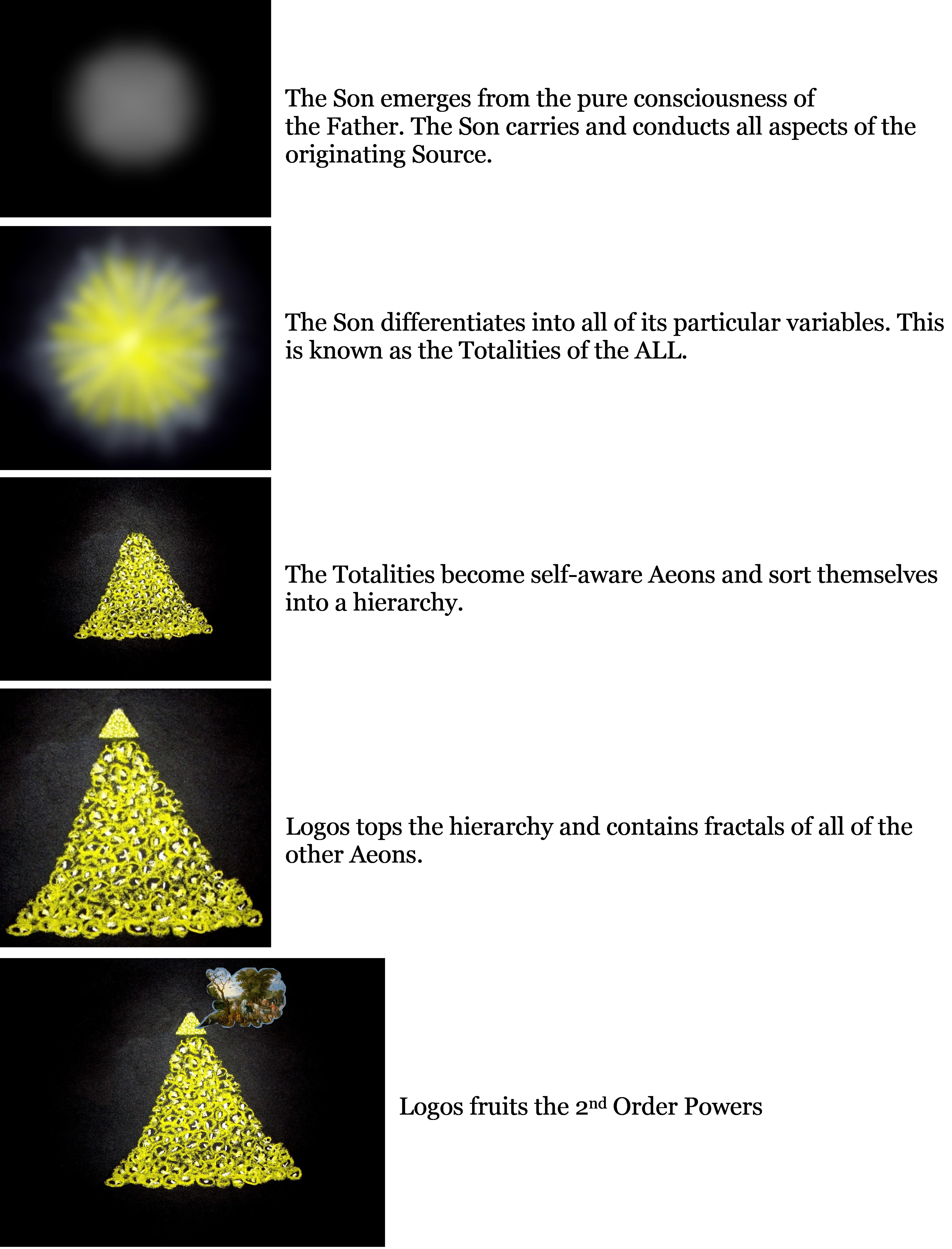
So this is saying that the Son is the extension of the Father. He’s the part of the Father that extended himself out and spread himself. And it is the Son who has firmness, location and a dwelling place. And it is the Son who is the ALL, who is the Totalities of the ALL. He is the sum of the ALL.
And it says they understood who he is because he is them and he is clothed. He wears the ALL like a garment, just the same way that we wear our bodies as a garment. Except it’s not exactly the same because most of our body is made up of this material universe that arose during the Fall. But the ALL and the Totalities of the ALL are pure consciousness, pure love and delight and joy. And that is in their totality what is called the Son.
On the other hand, that is the one by reason of whom he is called the Son, the one about whom they perceive that he exists and that they have been seeking him. This is the one who exists as Father and of whom one can neither speak nor think. He is the one who exists first.
That is, the Father existed first before the Son. But the Son is the one that we can perceive or that the Totalities can perceive. They can’t perceive directly the Father, but they can perceive his emanation, which is called the Son. Quoting again,
For no one can conceive of him or think of him or draw near to that place toward the exalted, toward the truly preexistent. [That would be the original Father they’re talking about.] But every name that is thought or spoken about him is brought forth in glorification as a trace of him, according to the capacity of each one of those who give him glory.
So this is saying that the full glory of the Father cannot be known. The Son can be known because he is coexistent with the Totalities of the ALL. So they are him and he is them. But the Father can be perceived as this trace. And in other places, it says like a sweet odor wafting to your nose.
That is the trace of the Father coming through the Father, coming through the Son, coming through the Totalities, coming through the Aeons. And that trace comes on through down to a Second Order Powers as well. We smell the beautiful aroma of the glory of the Father, even though we can’t know the Father. Quoting again,
He, however, whose light dawned from him, stretching himself out to give birth and knowledge to the members of the ALL, he is all these names without falsehood, and he is truly the Father’s only First Man. [So we’re talking about the Son again.] And the Son has no falsehood.
This is not a yin yang balance evil with good type of God. It’s all good. It’s all beautiful. It’s all glorious. And the Son is the First Man of the Father. This is saying that the Son is our prototypical human, the First Man. Quoting again,
This is the one I call the form of the formless, the body of the incorporeal, the face of the invisible, the word of the inexpressible, the mind of the inconceivable, the spring that flowed from him, the root of those who have been rooted, the God of those who are ready, the light of those he illuminates, the will of those he has willed, the providence of those for whom he provides, the wisdom of those he has made wise, the strength of those he has given strength, the assembly of those with whom he is present, the revelation of that which is sought after, the eye of those who see, the spirit of those who breathe, the life of those who live, the unity of those who are united.
Now this is saying that the Son wears all of those names, and the Son is all of that to the Totalities of the ALL. But again, as above so below, he is all of that to us as well. Quoting again,
While all the members of the ALL exist in the single One, that is the Son, the Son and the ALL are united, as he clothes himself completely, and in his single Name, he is never called by it. And in the same unitary way, they are simultaneously, this single One, as well as all of them. He is not divided as a body, nor is he split apart by the names in which he exists, in the sense that this is one thing and that is something else. Nor does he change by [and then there’s a missing word], nor does he alter through the names in which he is, being now like this and now something different, so that he would be one person now and something else at another time. Rather, he is entirely himself forever. He is each and every one of the members of the ALL eternally at the same time. He is what all of them are, as father of the ALL. And the members of the ALL are fathers as well. For he is himself knowledge for himself, and he is each one of his qualities and powers. And he is himself the eye for all that he knows, seeing all of it in himself, having a son and a form.
So you see, because the Son and the ALL are completely united, it’s saying that the Son sees them all at once, and the ALL sees the Son all at once, not split up into all of the various qualities, although the Father does see them all, because the Father knows all. Quoting again,
Thus his powers and qualities are innumerable and inaudible because of the way in which he gives birth to them. The births of his words, his commands, and his members of the ALL are innumerable and indivisible. He knows them, for they are himself. When they speak, they are all in one single name. And if he brings them forth, it is in order that they may be found to exist as individual qualities, forming a unity.
So this is talking about the Totalities of the ALL. That’s why they’re referred to as Totalities, because they are not individuals. They are part of this indivisible unity of the Son, and yet they’re all there in their individuality. They just don’t realize it, because they don’t know themselves as singular identities, because they form a unity that is the Son.
He did not, however, reveal his multiplicity at once to the members of the ALL, nor did he reveal his sameness to those who had issued forth from him. Now, all of those who have gone forth from him, that is, the Aeons of the Aeons, being emissions born of a procreative nature, also procreate through their own procreative nature to the glory of the Father, just as he had been the cause of their existence. This is what we said earlier. He makes the Aeons into roots and springs and fathers. For that which they glorified, they bore, for it possesses knowledge and wisdom, and they understood that they have gone forth from the knowledge and the understanding of the ALL.
So we’re talking about the Totalities. They are the Aeons of the Aeons. They are the direct parental units of what we then know as the Aeons of the Pleroma of God. But the Totalities were their forerunners, and they are the ones that are unified with the Son. And the Son, of course, is unified with the Father. However, these Totalities are like roots and springs and fathers, and they glorify the Father, they glorify the Son, and the things that they glorify, they give birth to. Quoting again,
If the members of the ALL had risen to give glory according to the individual powers of each Aeon, they would have brought forth a glory that was only a semblance of the Father, who himself is the ALL. For that reason, they were drawn through the singing of praise and through the power of the oneness of him from whom they had come forth, that being the Son, into mutual intermingling, union, and oneness. From their assembled Fullness, they offered a glorification worthy of the Father, an image that was One, and at the same time many, because it was brought forth for the glory of the One, and because they had come forward toward him who himself is the entirety of the ALL.
Okay, the Totalities, you see, have been giving glory to the Father in the direction of the Son, toward the Son. And that’s S-O-N, easy to confuse with S-U-N, but that would be a whole different set of mythologies.
And they had to all give glory together. That’s why they’re called Totalities. They didn’t give glory individually. They were one voice. They didn’t know themselves as individuals. They were all at once that one thing, the ALL. And it was the ALL giving glory all together in the direction of the Son and Father that caused them then to procreate.
Now we’re moving into a section called the Three Fruits of Glorification, and that’s chapter 68, verse 36 through 70, verse 19.
This then was a tribute from the Aeons to the one who had brought forth the ALL, a first fruit offering of those who are immortal and eternal. [That’s the Father and the Son.] For when it issued from the living Aeons, it left them perfect and full, caused by something perfect and full, since they were full and perfect, having given glory in a perfect manner in communion.
So what this is saying is that nothing was diminished. Everything was full and perfect because they all together sang their glory without personal identification. It was all for one and one for all.
For inasmuch as the Father lacks nothing, he returns the glory they give to those who glorify to make them manifest by what he himself is. The cause that brought about for them the second glorification is, in fact, that which was returned unto them from the Father . When they understood the grace from the Father through which they had borne fruit with one another, so that just as they had been bringing forth by glorifying the Father, in the same way they might also themselves be made manifest in their act of giving glory, so as to be revealed as being perfect.
So that is the second glorification that is being described. The glory that they were giving, that the Totalities gave to the Father and the Son, reflected back onto them without any loss or diminishment. It’s full and complete.
You know we’re talking about fractal formulas, right? The Son is a fractal of the Father . The Totalities are the pure, complete, fractal formula of the Son, and they give glory to the Son and the Father without being diminished whatsoever, because they do it in unison, in full communion. So then,
They became fathers of the third glorification, [or we could say the third iteration of the fractal.] They became fathers of the third glorification, which was produced in accordance with the free will and the power they had been born with, enabling them to give glory in unison while at the same time, independently of one another, according to the will of each.
You see now, this is how the third glorification, or the third iteration, differs from the second iteration. The second glory had to all give glory, all together, all at once, all the time. They had no personal identity. But in that giving of glory, they gave birth to the third glorification, which showed each of those Aeons that they had free will.
Thus, both the first and the second glorifications are perfect and full, for they are manifestations of the perfect and full Father and of the perfect things that issued from the glorification of him who is perfect. The fruit of the third glorification, however, is produced by the will of each individual Aeon and of each of the Father ‘s qualities and powers. This fruit is a perfect fullness to the extent that what the Aeons desire and are capable of in giving glory to the Father comes from their union as well as from each of them individually.
You see, here we have the birth of ego. Because ego is identification of individuality, whereas the pure Self was further up line—that is the ALL, the Totalities, the Son. We have both of those characteristics within us.
We have the Totalities of the ALL that we generally call our Self with a capital S. That is the pureness of God that reflects the totality of the Father and the Son, without shadow or blemish or fault. And then we have ego, which is recognition of our individuality and our individual free will. And it differs from the one Self because we are singing our own song of praise from our position.
That’s our ego.
For this reason, they exist as minds over minds, words over words, superiors over superiors, degrees over degrees, being ranked one above the other. Each of those who glorify has his own station, rank, dwelling place, a place of rest, which is the glorification he brings forth.
And each of us as well has our own place, position, place of rest, duties and whatnot. And that is our ego identification and the free will that we exercise through our ego.
Our entire unit of consciousness, as I would put it in the Simple Explanation of Absolutely Everything, our entire unit of consciousness consists of the Self, which is the One, and the ego, which is our individuality and our personal will. That is our unit of consciousness. I am all that. Plus, I have this body that attached to me when I came down here into this material world.
So the First Fruit is the totality of the ALL that is coexistent with the Son. The Second Fruit is when the Son and Totalities gave glory to one another and that produced the Aeons of the Fullness and they understood and were perfectly revealed. And then the Third Fruit is the Aeons of the Fullness of God, the third glorification by the will of the individual Aeons and their and the Father ‘s qualities and powers. That’s the Hierarchy of the Fullness—that’s the Third Fruit. And these are the ones that sit and dream of Paradise. And these are the ones who give glory together and in various combinations and produce us, the Second Order of powers.
I really love the language of the Tripartite Tractate. It’s very beautiful scripture. I think that the understanding we gain here by reading the Tripartite Tractate deepens the knowledge of who the Father is and who the Son is and what the Aeons are. This is not an assembly of mythological characters. This is pure consciousness emanating from the Source and flowing out to us with consciousness, love, free will, joy, and the desire to seek after the Father. We inherit all of that from the Aeons and the Aeons of the Aeons and the Son.
So until next week, onward and upward, and God bless us all.

 Visit Podcast Website
 RSS Podcast Feed
 Subscribe
 Share
Share
 Add to MyCast